1
Moisture mapping and baseline
Thermal imaging and moisture meters locate every wet material. We also record readings from unaffected reference materials to set the dry goal for your specific building.
Structural drying is the controlled removal of moisture from walls, floors, ceilings, and framing after water damage. Jacksonville Water Damage Solutions uses air movers, dehumidifiers, moisture meters, and drying documentation to help return affected materials to appropriate dry conditions.
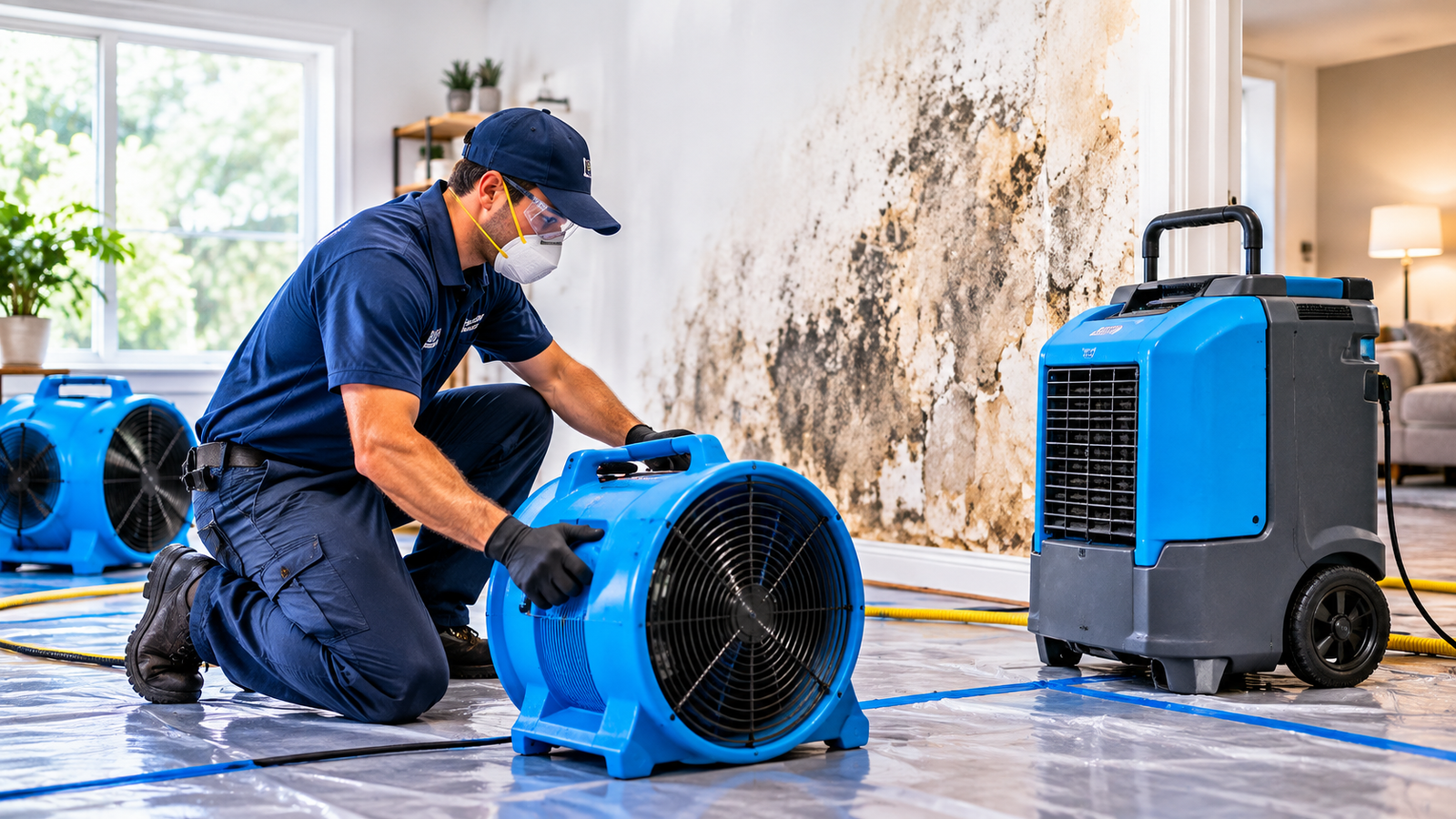
Drying is engineering, not just fans. Each job gets a written drying plan and daily proof that it is working.
Thermal imaging and moisture meters locate every wet material. We also record readings from unaffected reference materials to set the dry goal for your specific building.
Equipment is sized to the cubic footage, damage class, and materials following IICRC S500 guidance, not guessed. Too little equipment stalls drying, and too much wastes energy.
Air movers create directed airflow across wet surfaces and into wall cavities so moisture evaporates out of the material and into the air.
Dehumidifiers pull the evaporated moisture out of the air. Without them, Jacksonville's humid air stops materials from giving up their water.
Where needed we drill small holes, remove baseboards, or lift flooring so warm dry air reaches insulation, framing, and the layers under the floor.
A technician returns each day to re-read moisture, adjust equipment, and record results. When every reading meets the dry goal, we remove the equipment and give you the drying log.
We choose the method by the materials, the damage class, and the conditions inside your building.
Low grain refrigerant (LGR) dehumidifiers are the workhorse for most Jacksonville losses. They chill air to condense moisture and work best in warm rooms above about 70 degrees, which describes most of our year. They suit homes, offices, and standard Class 2 losses. The differentiator is efficiency: LGR units remove more water per hour than conventional units, which usually shortens the drying period.
Desiccant dehumidifiers use an absorbent wheel instead of cooling coils, so they keep working in cooler spaces and at very low humidity. They are best for deep Class 3 and 4 losses, dense materials, and unheated buildings. The differentiator is drying power at the bottom of the humidity range, where refrigerant units slow down, which is why we bring them for hardwood and stubborn framing.
Hardwood floors are dried with mat systems that pull moisture up through the boards using negative pressure, instead of tearing the floor out. They suit owners of solid and engineered wood floors in older Riverside and Avondale homes. The differentiator is saving the floor: when water is caught early, drying in place can avoid the cost and disruption of full replacement.
This method dries the space inside walls and above ceilings by circulating warm dry air through small openings, so drywall and insulation are not torn out unnecessarily. It is best for clean-water leaks caught early, including upstairs pipe failures. The differentiator is precision: we dry and verify the cavity with meters, and remove only the material that fails the moisture check, which keeps repair costs and disruption down.
Water that looks gone can still be inside the structure. These signs mean moisture is still present.
We choose equipment by the conditions on your job. Here is how the two main dehumidifier types differ.
| Factor | LGR (refrigerant) | Desiccant |
|---|---|---|
| How it works | Chills air so moisture condenses on coils | Absorbs moisture into a rotating desiccant wheel |
| Best temperature range | Warm rooms, roughly 70 degrees and above | Works in both cool and warm conditions |
| Lowest humidity reached | Moderate; slows near the low end | Very low; strong at the end of drying |
| Best jobs | Most homes and offices, Class 1 to 3 losses | Class 3 and 4 losses, hardwood, dense framing |
| Energy use | Lower | Higher |
We scan the building with thermal imaging and moisture meters and record baseline readings from dry materials.
We calculate the equipment needed from room volume and damage class and set a target dry goal.
Air movers and dehumidifiers are positioned to push and pull air across every wet surface.
Where moisture is trapped, we open wall cavities, lift baseboards, or set floor mats so air can reach it.
Technicians return daily to re-read moisture, adjust equipment, and log results.
When every reading meets the goal, we remove the equipment and give you the final drying log.
Drying is usually priced by equipment days and labor, not a flat fee. The number of air movers and dehumidifiers, and the days they run, drive the total. Most work is billed directly to your insurance carrier.
| Cost factor | What is evaluated | Why it matters |
|---|---|---|
| Affected area | Number of rooms, floor area, and cubic footage | Larger or multi-room losses may require more equipment and labor. |
| Water damage class | Amount of water and materials affected | The damage class influences drying strategy and equipment needs. |
| Equipment duration | Air movers, dehumidifiers, and monitoring days | Longer drying periods generally require more equipment time and visits. |
| Specialty drying | Hardwood, wall cavities, subfloors, or difficult-to-access areas | Specialized systems and additional monitoring may be needed. |
Every project is priced from an on-site inspection. Call (904) 467-6998 for a written estimate. We bill most insurance carriers directly.
Most residential structural drying takes 3 to 5 days, and heavy Class 3 or 4 losses can take a week or more. Timing depends on the materials, the humidity in your building, and how quickly extraction happened. We start drying the same day as extraction whenever possible. Call (904) 467-6998 to schedule a moisture inspection today.
We dry homes and businesses across Jacksonville, from Westside neighborhoods near our Blanding Boulevard base to the river communities and the beaches.
The following is a representative service scenario, not a customer case study or a claim about a specific completed project.
A typical Jacksonville water-loss response may begin with a supply-line leak or other plumbing failure that leaves flooring, drywall, baseboards, or framing damp. The drying team first identifies affected materials, records moisture readings, and establishes dry-reference readings before selecting equipment. Air movers and dehumidifiers are then positioned according to the affected area, with follow-up monitoring used to adjust the setup as moisture levels change.
We treat drying as measurable work. You get moisture readings before, during, and after, so you know exactly when your building is dry. Our technicians are IICRC-trained, and our documentation is built for insurance adjusters. Our office is at 3811 Blanding Blvd in Jacksonville, and our crews are on call every day.
We compare moisture readings against unaffected reference materials in your own building and keep drying until every wet material meets that goal. You get the daily log as proof.
Most homes need 3 to 5 days, and heavy losses can take longer. Humidity, materials, and how quickly the water was removed all affect the timeline.
Household equipment cannot move enough air or pull enough moisture to dry wall cavities and subfloors, especially in our humid climate. Partial drying is a leading cause of hidden mold.
Drying equipment does use power. Many insurers account for it in the claim, and we can estimate the added electricity for you when we set up.
Often, if they are caught early. We use floor-drying mat systems that pull moisture up through the boards, and we tell you honestly if a floor is beyond saving.
Not always. For clean-water leaks caught early, we can dry the cavity through small openings and verify with meters. We remove drywall only when readings show it will not dry, or when contamination is involved.
It is usually covered when a sudden event like a burst pipe causes the loss. We provide the moisture maps, photos, and drying logs your adjuster needs.
Tap to call our 24/7 emergency line, or request a free inspection and we will respond fast.
Jacksonville Water Damage Solutions